Walk into any jewellery showroom in the city, and you will be greeted by glittering displays, friendly staff, and a price board showing the Today Gold Rate for the day. What the board does not tell you is whether the piece in your hand is truly the purity it claims to be. That question matters enormously, because a small difference in carat quality translates into a real difference in what you pay and what you can recover later. Even a buyer who follows Gold Rate Today Hyderabad closely can be misled if purity is not verified properly. Fortunately, India has a well-developed system of hallmarking designed to protect consumers, and learning to read it takes only a few minutes. This guide explains what the numbers and marks mean and how to use them to shop with confidence.
What Carat Purity Really Means
Carat is the measure of purity of gold in a given piece. Twenty-four carat gold is virtually pure, about ninety-nine point nine per cent, and is bright yellow, soft and easily dented. It has mainly been used for coins, bars and investment products rather than everyday ornaments because of its relative softness. Twenty-two carat gold contains ninety-one point six per cent gold plus metals like copper and silver to make it strong, and is the preferred grade for traditional Indian jewellery. Eighteen carat gold has seventy-five per cent gold content and is the preferred gold for diamond-studded and contemporary designs because it is hard enough to hold the diamonds in place. Other lower purities such as fourteen carat gold are also available and can be used for fashion jewellery. The price per-gram reduces as the carat decreases, so it is extremely important to compare rates for the same purity, and to be wary of any offers too good to be true for the quality being advertised.
The Role of BIS Hallmarking and HUID
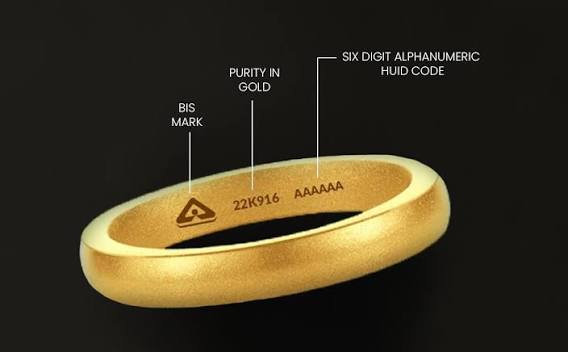
To protect buyers, the Bureau of Indian Standards has a hallmarking scheme, whereby jewellery is tested and certified at authorised centres. A hallmark on a piece contains the BIS logo, the purity in a number, for example 916 for twenty-two carat, the grade expressed as a letter, and a unique six-character alphanumeric code called the HUID, or Hallmark Unique Identification. This code is given to each individual article and stored in a database and can therefore be traced. Hallmarking has become mandatory for gold jewellery in many parts of the country, and registered jewellers are obliged to sell only hallmarked articles in the notified categories. As a buyer, you benefit from a greater level of transparency than existed a generation ago. You do not have to rely solely on the jeweller’s word, or go to the expense of getting a third party to test the purity of a piece. You can look out for pieces that have a valid hallmark, as this provides a kind of lifelong guarantee of their quality and purity.
Checking a Piece Before Paying
Verification does not have to be complicated. First of all, look out for the hallmark on the jewellery piece itself, which is often marked discreetly in a bangle or near the clasp of a chain. Ask the jeweller for the BIS logo, the purity number, and the HUID code. The Bureau of Indian Standards has a mobile application where in you can enter the HUID and check the type of article, the purity, and the hallmarking centre. Compare this to what is written on the invoice, as there are red flags if these do not match up. Ask the jeweller to show you the weight of the piece on a scale, and ask whether the weight quoted includes stones or other non-gold elements, which are usually priced separately. If a jeweller is hesitant to give you these details, it is probably wise to take your business elsewhere. Reputable sellers should not have a problem with showing the necessary transparency since you are building long-term trust.
Common Mistakes to Avoid
Several mistakes can cause buyers trouble. One mistake is to accept un-marked or old pieces as equal in quality to hallmarked pieces simply because they appear the same. Another mistake is to assume all the jewellers will apply the same standard for the purity of old gold when you come to exchange, when they may assess the content differently or cut the rate. A third common mistake is to ignore the invoice, which should include details on purity, weight and hallmark, as this will help you in case of any exchange, insurance claims or disputes. Buyers should be careful when it comes to gold-plated or gold-filled items marketed attractively but containing only a thin surface layer of gold and little or no resale value. Remember, too, that hallmarking certifies purity but does not comment on the design or whether making charges are reasonable, so continue to compare estimates. A careful approach will protect your money and your peace of mind.
Hallmarking has made buying gold jewellery far safer than in the past, but the protection works best if buyers utilise it. Know the grades of purity, check the marks, the code and the bill. These measures will take a little time, but they will transform a risky purchase into an informed one.